The right exercise · Lesson 6
Calf raises: toes in or out, what does it change?
It changes which side of your calf grows most. In 22 young men, after 9 weeks of calf raises on a leg press, the medial gastrocnemius, on the inside of the calf, got 8.4% thicker toes out versus 3.8% toes in, and the lateral gastrocnemius 9.1% thicker toes in versus 5.5% toes out. To fill out the inside of your calf, point your toes out; for the outside, point them in.
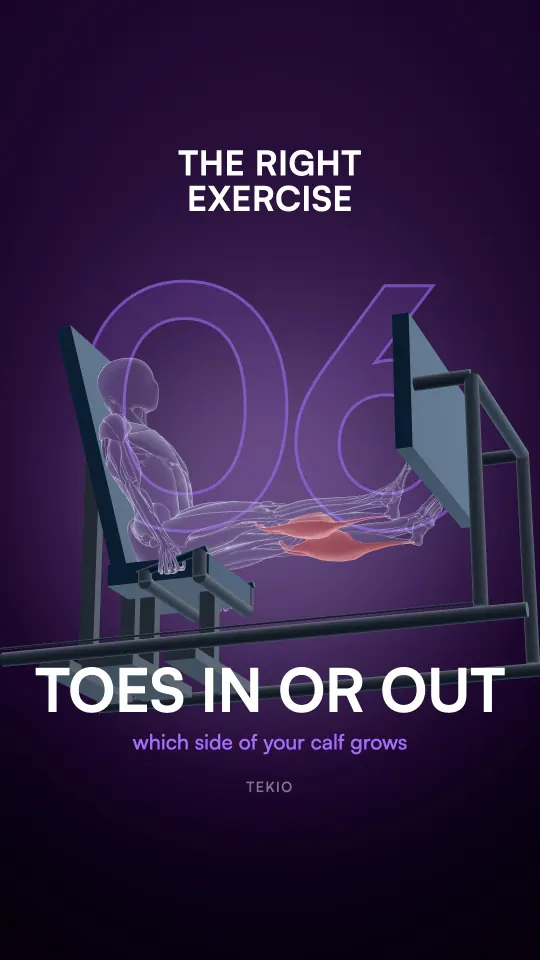
What are the two heads of the gastrocnemius?
Under the skin of your calf sit two muscles side by side: the medial and the lateral gastrocnemius, or gastrocs. The medial head starts at the bottom of your femur on the inner side, on the medial condyle; the lateral head on the outer side, on the lateral condyle (Arefi et al., 2023). At the bottom, they pull on your heel through the Achilles tendon, each through its own part: the tendon is made of three subtendons, one for each gastrocnemius head and one for the soleus, hidden underneath (Lecompte et al., 2024).
They’re not the same size: on MRI, in 13 men, the medial head made up 32% of the volume of the three calf muscles, the lateral head 16%, half as much (Albracht et al., 2008). Together, they raise you onto your toes: that’s plantar flexion.
Toes out or in: which head works harder?
Turning your feet on calf raises to target one head or the other is common practice, and in 2011 it rested on little measurement. So one team recorded the electrical activity of both heads in 20 lifters, 10 men and 10 women, doing standing calf raises with a load of 130 to 135% of their body weight. Toes out, the medial head was more active than the lateral; toes in, the lateral more than the medial (Riemann et al., 2011).
Other measurements point the same way, with one nuance. In 33 young adults, toes out, the medial head was more active than the lateral; but toes in, neither one dominated (Cibulka et al., 2017). In 37 runners, 18 of them with Achilles tendinopathy, pushing without moving, the lateral head was more active toes in than with feet straight (Fernandes et al., 2025).
That’s measured muscle activity, not growth: the first team says so itself, its study can’t tell whether these gaps build more muscle with training (Riemann et al., 2011).
Why does turning your feet change which head works?
Because your nervous system splits its drive between the two differently. In 19 men pushing without moving, feet turned in or out, researchers estimated the nerve drive reaching each head: it was stronger toes out for the medial head, and stronger toes in for the lateral one. The nerve pathways to these muscles didn’t become easier to excite: for the authors, that’s not the mechanism, and the real reason for this split is still to be found (Crouzier et al., 2024).
And when you turn your feet, your ankle barely turns: in 20 lifters doing standing calf raises, the rotation came first from the hip, then the knee, and very little from the ankle (Arnsdorff et al., 2011). It’s your whole leg that turns.
Toes in or out: which one grows your calves?
One study measured growth: 22 young men, 23 years old on average, followed a full-body program three times a week for 9 weeks. Their calves trained on a horizontal leg press, one leg at a time, in 3 sets of 20 to 25 reps, then 4 sets from week four. Each leg was randomly assigned one position: toes out, toes in or toes forward. The thickness of both heads was measured by ultrasound (Nunes et al., 2020).
The medial head got 8.4% thicker toes out, 3.8% toes in and 5.8% toes forward; the lateral head 9.1% toes in, 5.5% toes out and 6.4% toes forward. Between toes out and toes in, the gap was statistically clear. So both heads grew in all three positions: what changes is which side grows most, and with feet straight, each lands in between.
How should you place your feet next session?
To fill out the inside of your calf, point your toes out; for the outside, point them in. With your feet straight, both heads grow, each in between.
Limits: it’s a single growth study, in young men, over 9 weeks, measuring a thickness by ultrasound rather than the muscle’s volume. Its abstract doesn’t say how far the feet were turned. And each leg trained in one position only: the study doesn’t tell what alternating the two would do.
Your workout plan, built for your body.
In Tekio, your plan targets your calves and you watch them progress on your body, week after week.

Sources
Studies checked in PubMed. Measured muscle activity isn’t growth: each fact keeps its study’s population and limits.
- Arefi IA, Kosco E, Werner E, et al. (2023). Bilateral Gastrocnemius Tertius Muscles: Cadaveric Findings of a Rare Variant. Cureus 15(9):e45316. PubMed · DOI
- Lecompte L, Crouzier M, Baudry S, et al. (2024). Estimation of the Achilles tendon twist in vivo by individual triceps surae muscle stimulation. J Anat 246(1):86-97. PubMed · DOI
- Albracht K, Arampatzis A, Baltzopoulos V (2008). Assessment of muscle volume and physiological cross-sectional area of the human triceps surae muscle in vivo. J Biomech 41(10):2211-8. PubMed · DOI
- Riemann BL, Limbaugh GK, Eitner JD, et al. (2011). Medial and lateral gastrocnemius activation differences during heel-raise exercise with three different foot positions. J Strength Cond Res 25(3):634-9. PubMed · DOI
- Cibulka M, Wenthe A, Boyle Z, et al. (2017). Variation in medial and lateral gastrocnemius muscle activity with foot position. Int J Sports Phys Ther 12(2):233-241. PubMed
- Fernandes GL, Orssatto LBR, Shield AJ, et al. (2025). Effect of foot position during plantarflexion on the neural drive to the gastrocnemii in runners with Achilles tendinopathy. Eur J Appl Physiol 125(7):1949-1959. PubMed · DOI
- Crouzier M, Avrillon S, Hug F, et al. (2024). Horizontal foot orientation affects the distribution of neural drive between gastrocnemii during plantarflexion, without changing neural excitability. J Appl Physiol (1985) 136(4):786-798. PubMed · DOI
- Arnsdorff K, Limbaugh K, Riemann BL (2011). Analysis of Heel Raise Exercise with Three Foot Positions. Int J Exerc Sci 4(1):13-21. PubMed · DOI
- Nunes JP, Costa BDV, Kassiano W, et al. (2020). Different Foot Positioning During Calf Training to Induce Portion-Specific Gastrocnemius Muscle Hypertrophy. J Strength Cond Res 34(8):2347-2351. PubMed · DOI
These lessons inform; they don’t replace advice from a health professional.